Recently I started a broadcast channel on my Instagram page and I am delighted to say that many people joined. To celebrate the occasion I wanted to do something special —I asked the newcomers to post questions for me, which many of them did! It has been very rewarding and a great occasion for introspection, for which I am sincerely thankful.
At the same time, I realized that my answers were too lengthy, particularly for the broadcast channel. Some of them go into deep topics, and I find myself wanting to provide more in-depth responses than Instagram allows. At the same time, I've been postponing blog updates in recent weeks, so I thought this was the perfect opportunity to return to it. I hope you appreciate the added level of detail, and if you would like to ask me a question yourself, please feel free to join the channel here.

What are the fundamentals of Shibari?
Not only does the broadcast channel feel too narrow for this question, but even my blog might not suffice! It's undeniably a complex topic, one that would likely require an entire book to address adequately. Instead, I would like to describe some dimensions of how I understand my own practice and vision. I believe Shibari is a vast and multifaceted art form. While relatively new, it has deep roots in Japanese culture and identity, and in recent years, it has found a global community, practiced in diverse contexts with varying intentions.
That being said, for me, it has been incredibly valuable to consider the following dimensions of Shibari: technique, practice, and aesthetics. I believe Shibari is the perfect blend of these three elements, which is what makes it so fascinating and rich. In this post, I will explain what I mean by each of them and discuss what I consider to be the fundamental aspects of each dimension. It's important to note that even though I'm addressing them individually, they are all intricately connected and interdependent.
The technique
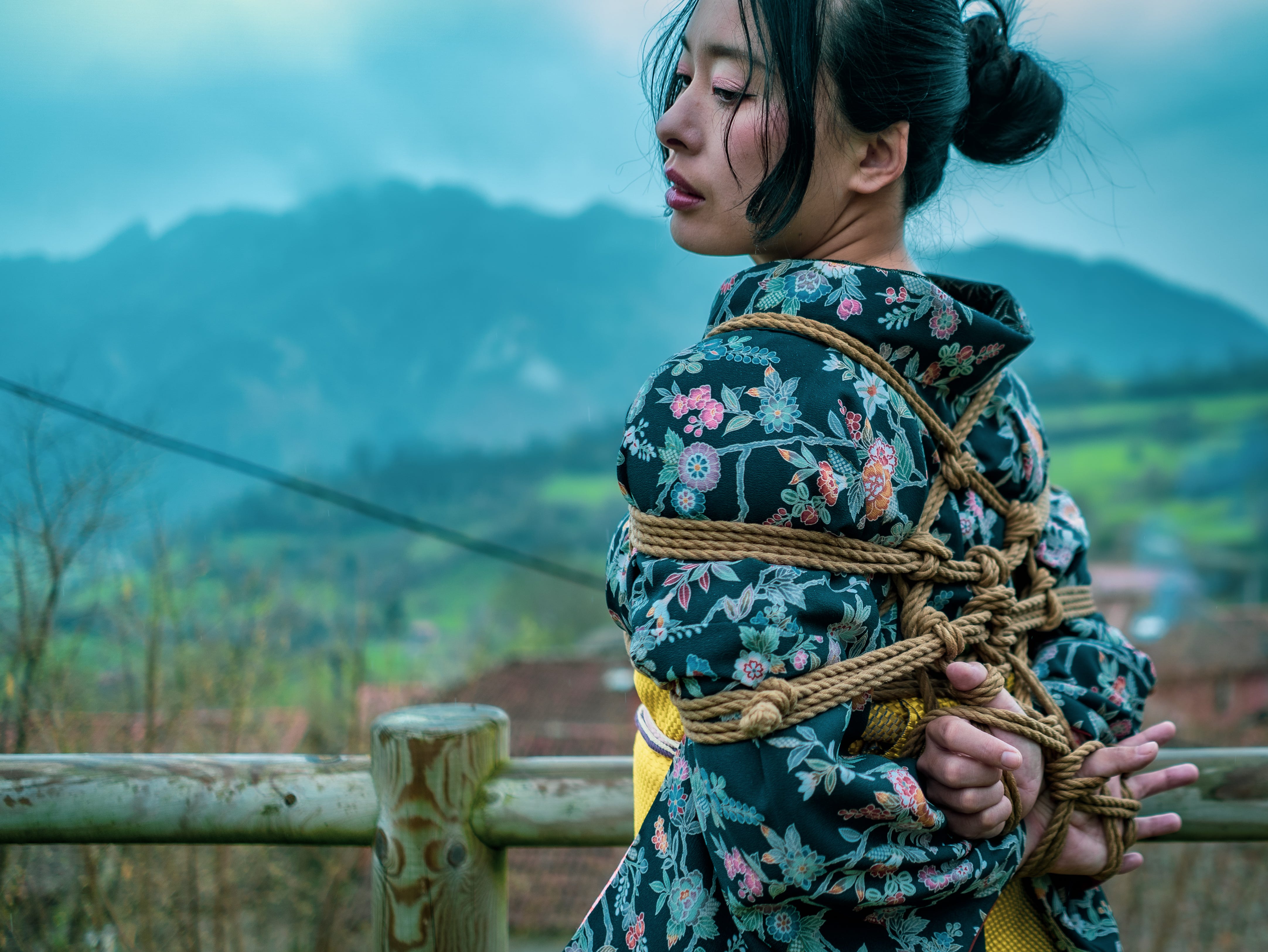
Although Shibari can be described in many different ways, something that it is difficult to argue is that ropes play an essential role in it. The name itself is a nominalization of the verb Shibaru 縛る (to tie) which means that in order to practice Shibari we need to learn to manipulate rope to a certain degree. The amount of technique that you need really depends on your practice and the aesthetic level that you would like to achieve. But what is the fundamental? I believe if you learn how to tie a square knot you can already do many things. The square knot is basically a way to create a loop of rope that can be as long as you want (so you can wrap it around one leg, two legs, one wrist, one hip, one tree…) and that it doesn't slide (which is very important as long as you don't want to strangle your limbs of the limbs of your partner.) Once the rope is attached somewhere (and I recommend starting either from the wrist or the ankle), you need to learn how to bring the rope somewhere else. For this you need to learn human anatomy, where it is safe and where it is not safe to place the rope. But don't be scared, as a rule of thumb, if you are not applying too much pressure and you are actively listening, you should be safe in the beginning. By all means don't try to do suspensions until you understand how the ropes work. Ropes have an internal logic and some sort of language. Following recipes is ok to learn but it is more important to understand the reasons behind the tricks. It took me around two years to do my first suspension after going to private classes once or twice a week! Please be patient and learn to enjoy the journey. There is so much to savor on the very basics, which brings us to the next dimension of Shibari.
The practice
With this I mean the actual time that you spend tying. Here the most important thing to remember is that every person is different. It doesn't matter what you learned before or how things are supposed to be. The person you are tying is the ground truth for how things should be, and to learn how to discover that truth is the biggest power of Shibari. Before you start I recommend that you think about the intention: Are you trying to learn new techniques or to practice something you just learned? Are you trying to give the other person a space to develop an emotion or to experience a sensation? Are you trying to create something out of the experience such as a photograph or a performance? Don't get frustrated because you really cannot do these three at the same time. Of course you are always learning, your partner will always feel something, and you can always take a picture. But if you learn to focus on one over another the whole experience will be more fruitful and enjoyable. From the very beginning start developing yourself around what you do. How you practice is the most important aspect of Shibari. Why are you doing this? What does it tell you? What do you have to express? Do a lot of introspection after each session to understand what went well and what went wrong. Nobody can teach you that except the experience. This is why each session is precious. For me each session is a ritual towards somewhere, to an extent, towards yourself. This is for me where the spirituality of Shibari lies. Which comes very close to the last dimension.
The aesthetics
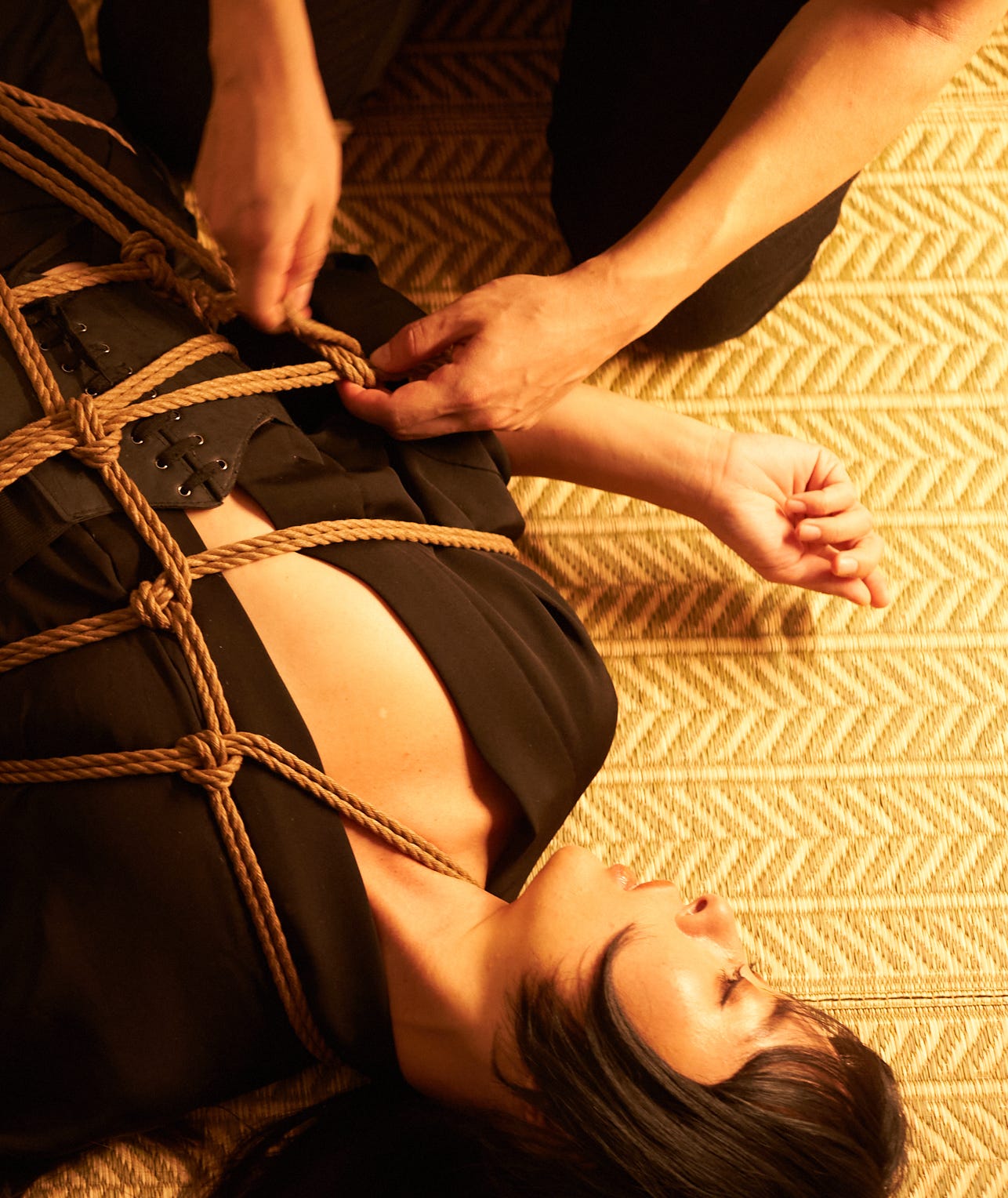
For many people the artistic part of Shibari is mostly secondary, and Shibari is understood as a way of doing something, reduced to its purpose. I really believe that in doing so they are missing the whole point, because in Shibari, as with many other traditional Japanese arts, function and aesthetics are indivisible. Even if you don't take pictures and you only tie with your partner without anyone else to see, you are creating an experience that has aesthetic implications, even if only momentarily. Consider what art means to you and how it conveys your values and the values of the culture it is coming from. With this I don't mean to think on how things look, or to focus on the frills, but more to think about the meaning of what you are doing and to see the practice as a crystallization of that meaning. Learn to appreciate the masters, to find the symmetry or asymmetry in their designs, learn how those designs exist for a reason, and discover yourself how function and aesthetics come together. If you do want to create something that can be shared with others, think about what you want to do. In my experience this is mostly photography or video, performances, and installations. Each of them has their own characteristics. Take Shibari as an opportunity to explore topics that you are interested in. And please share with me what you create!
And that's it! Thinking about Shibari in these three dimensions has been very useful for me and I hope it can help you as well in your rope journey. Remember that all of them, technique, practice, and aesthetics, come together to form a whole, the same way that the three Tomoe’s (三つ巴)express an indivisible unit hidden in the coexistence of its parts.
Thank you very much for your attention. If you enjoy this content, please consider to subscribe to my blog and to share it with your network.
Pablo Shibari