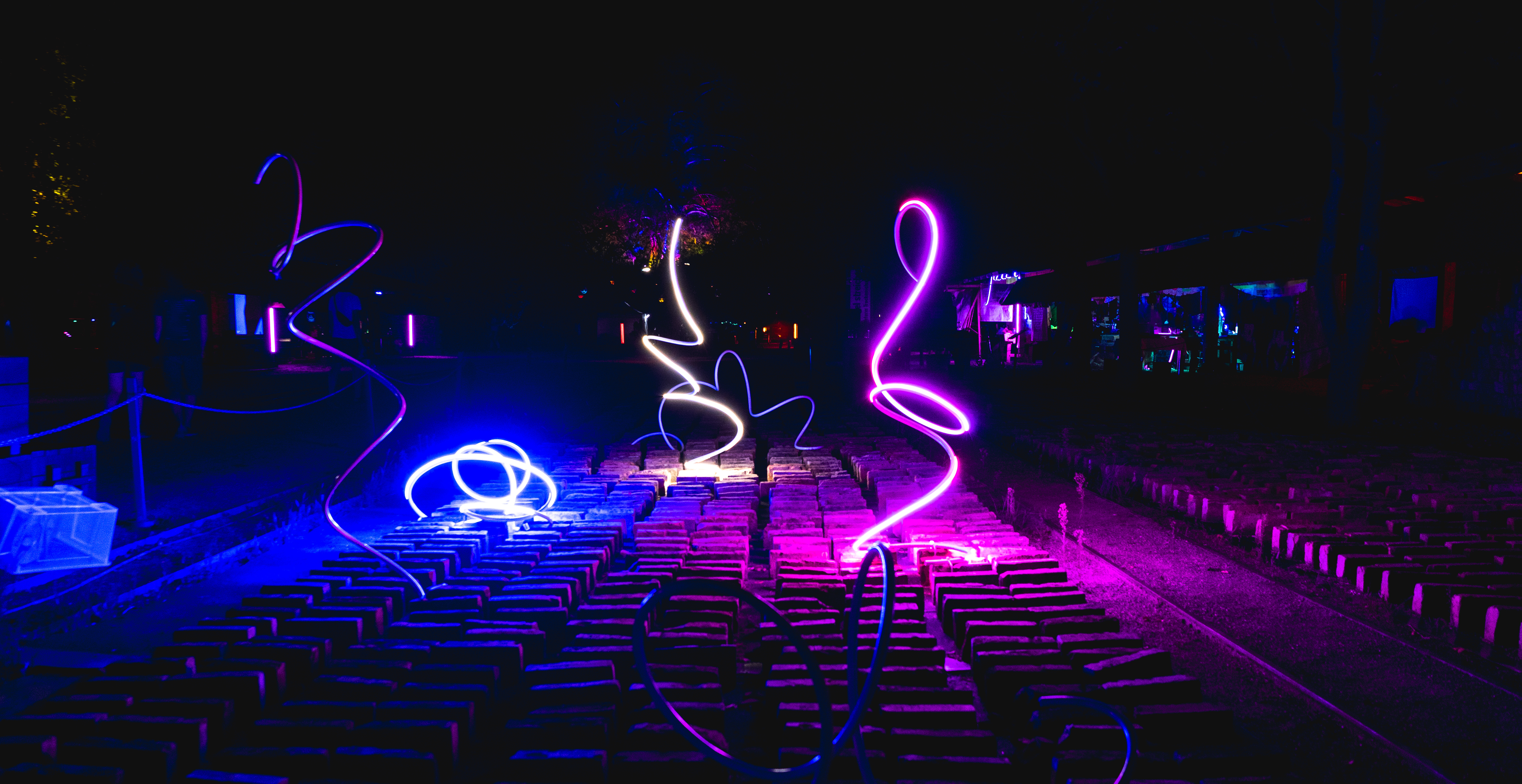
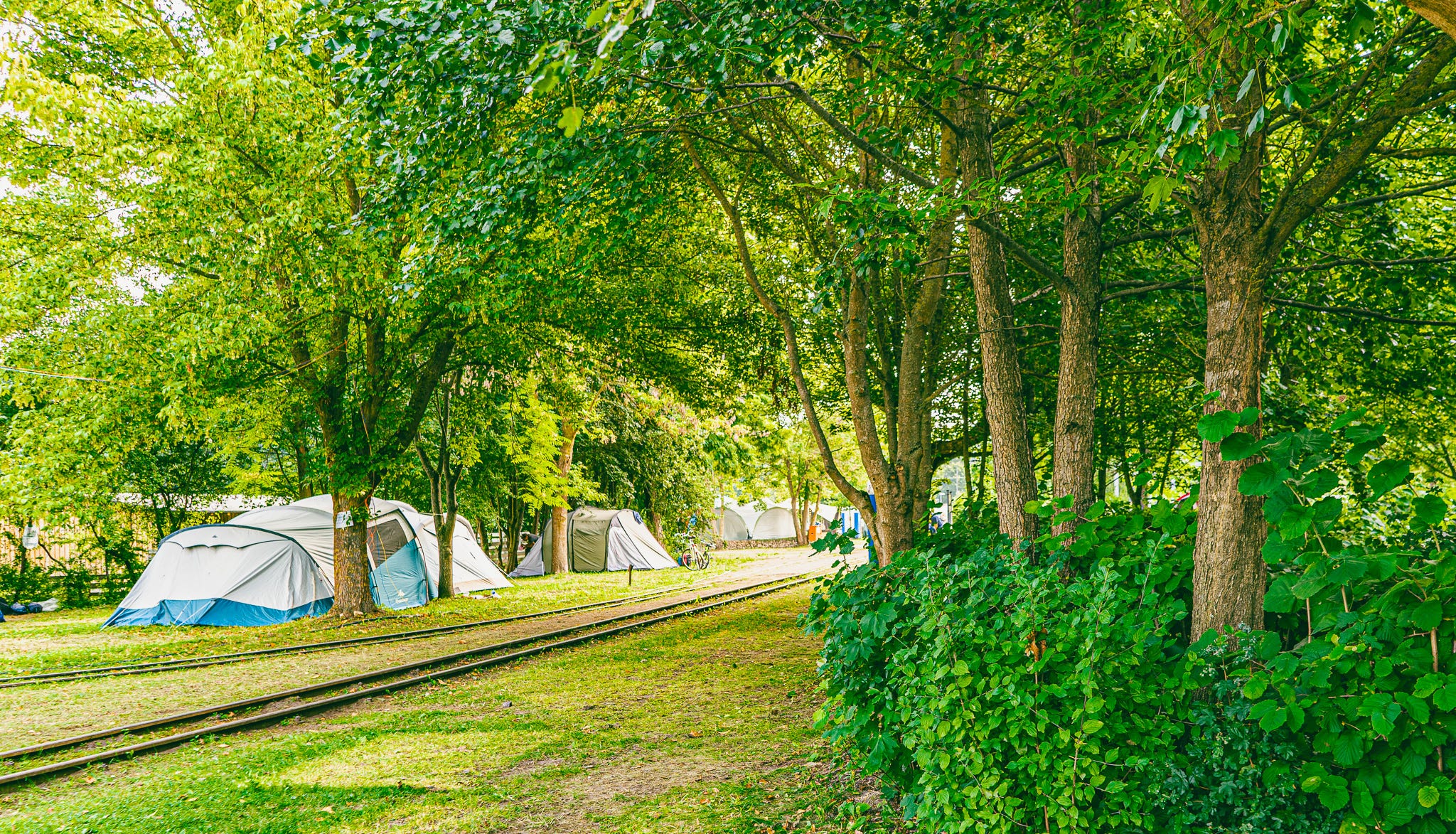
I am writing this post at the conclusion of the Chaos Communication Camp (CCC), a German convention of hackers, makers, artists; one of my favorite places on Earth. During my time here, I had the tremendous honor of conducting a series of Shibari workshops, in addition to assisting in a fire performance and collaborating on a light installation.
Together with my friend Reiterer, his partner Bernhard, and my wife Ai, we created a space called "String that connects us." The area exhibited two interactive LED installations, a fire pit for workshops and performances, and a Shibari stage for rope jamming. It has been a fantastic experience and many people enjoyed the lights, the fire, and the ropes. I am very happy I could share my passion for Shibari with all the attendees. CCC is indeed a very chaotic and serendipitous event, we were also spending time with our one-and-a-half-year-old daughter, which only adds to the fun. We made many friends and learned many things, and we leave with recharged batteries and many plans, many ideas to create before the next camp in 4 years.
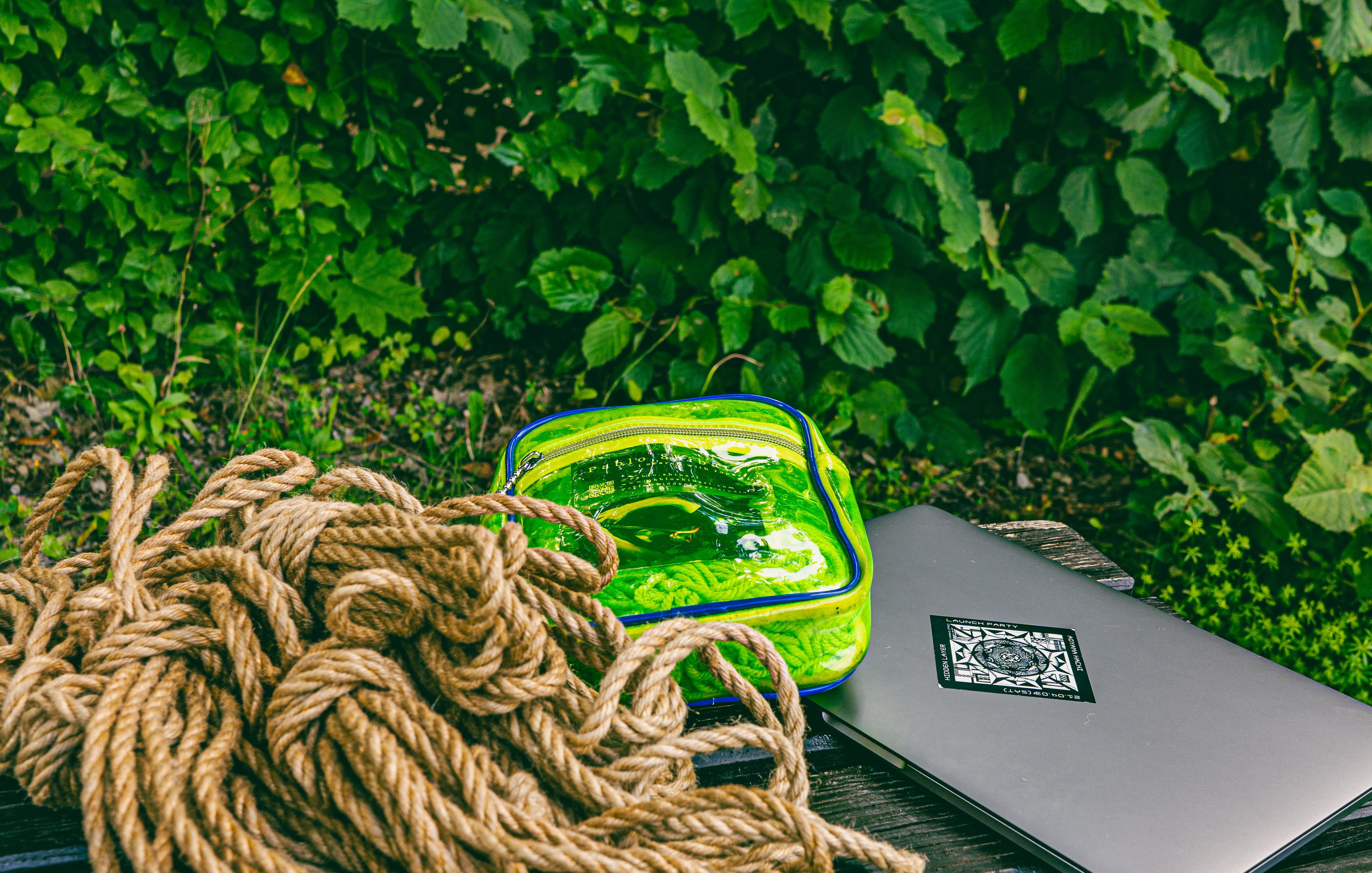
In this post, I would like to write about the workshops I conducted. There were three in total, each of them different, as I wanted to adjust the content to the participants' interests. The first one was centered around the idea of intention, how to tie in a way that conveys our feelings and emotions, creating opportunities for communication with our partner. The second was about the basic square knot, applied to the first rope of the Gote (後手, with hands on the back), incorporating some of the techniques I have been developing over the years: how to tie it in a fast and reliable way that allows us to keep our partner in mind. The last workshop became a self-tying session focused on the Futomomo (太腿, thigh). I enjoyed tying myself (it has been a while) and got to teach some improvisation techniques. Let's go one by one:
What does it mean to tie with intention?
For me, tying with intention means going beyond the ropes. It's about forgetting the ropes and focusing on feelings and sensations. How can you express your emotions to the person you are tying? In a sense, it is a mindfulness exercise, somehow, a shared one. Tying with intention requires confidence, and the ability to tie without having to stop to think about what comes next. The ropes fade away. It doesn't mean that you need to dominate all techniques deeply. Tying with intention is not an advanced practice. It is the simplest one. You don't need to tie a complicated pattern you don't know, and you can do a lot with just one rope and a simple Gote.
Before the beginning of the session think about what you want to do: do you want to practice something you don't know, or do you want to bring your partner on a journey? If you want to practice, you would need to stop here and there, going back and forth, and ask continuously how your partner is feeling, getting their precious feedback. Now I am talking about the second case when you want your partner to relax and let go, where you are developing a story and creating a space for discovery. Here you don't want to be wondering if what you are doing is right or wrong, you don't want to stop to think about what to do next. You want to be as close as possible to your body, your sensations, and you want to make every movement, every breath count, adding towards the same objective.
Most of the ideas here are related to the way you handle the rope: are you pulling it, are you placing it, are you holding it and keeping the tension, are you releasing it? "When" and "how" are the most important questions. If the rope becomes the point of contact, you want to make sure that your attention is on how the rope is feeling for you, through that, how your partner is feeling the rope, how are you feeling each other as if there were no rope. Some of the particular movements are almost impossible to convey in a text, and are related to small details during the execution: when to pull the rope and when to place it, when to grab and where to hold, when to go fast, and when to go slow.
Try to think about these questions next time you are tying: are you pulling the rope to close the knot or are you closing it with your fingers so our partner doesn't feel the movement? Are you grabbing the arms of your partner or are you holding them to listen to their flexibility?
Another important aspect is about making every movement count. For example, if your partner has long hair, how are you handling it? Try to keep it in the back, and then move it to the left and to the right every time the rope will go above it. Do it slowly, not as if the hair was on the way, but as if the rope gave you an opportunity to take care of the hair. Don't you like going to the hair salon and having someone wash your head gently? Don't you always think “why doesn't it last just a little longer?” The same goes for clothing or accessories. The goal is not to get someone tied up, the goal is to care about someone, to be there with them, to listen to their bodies, and to make them feel safe. Rope is just a vehicle.
The square knot
There are countless ways of tying a square knot, including variations of the knot itself and the process of tying the knot. It depends on the function and the location: are you tying an ankle with the ropes touching the skin, or two arms with a generous margin? Are you tying over a suspension point, or over a harness?
During one of the workshops I said that in Shibari you need only one knot, and someone said that it doesn't seem right, that they have seen many knots and patterns. I have been thinking about that conversation. What I was trying to say is that it all comes down to one thing: to attach the rope to something and start going forward. You can have many knots in the repertoire or you can have only one, and I don't think that matters much, especially at the beginning if you are not doing suspensions or tying tightly, which I don't think you should be doing even if you have memorized 20 square knot variations.
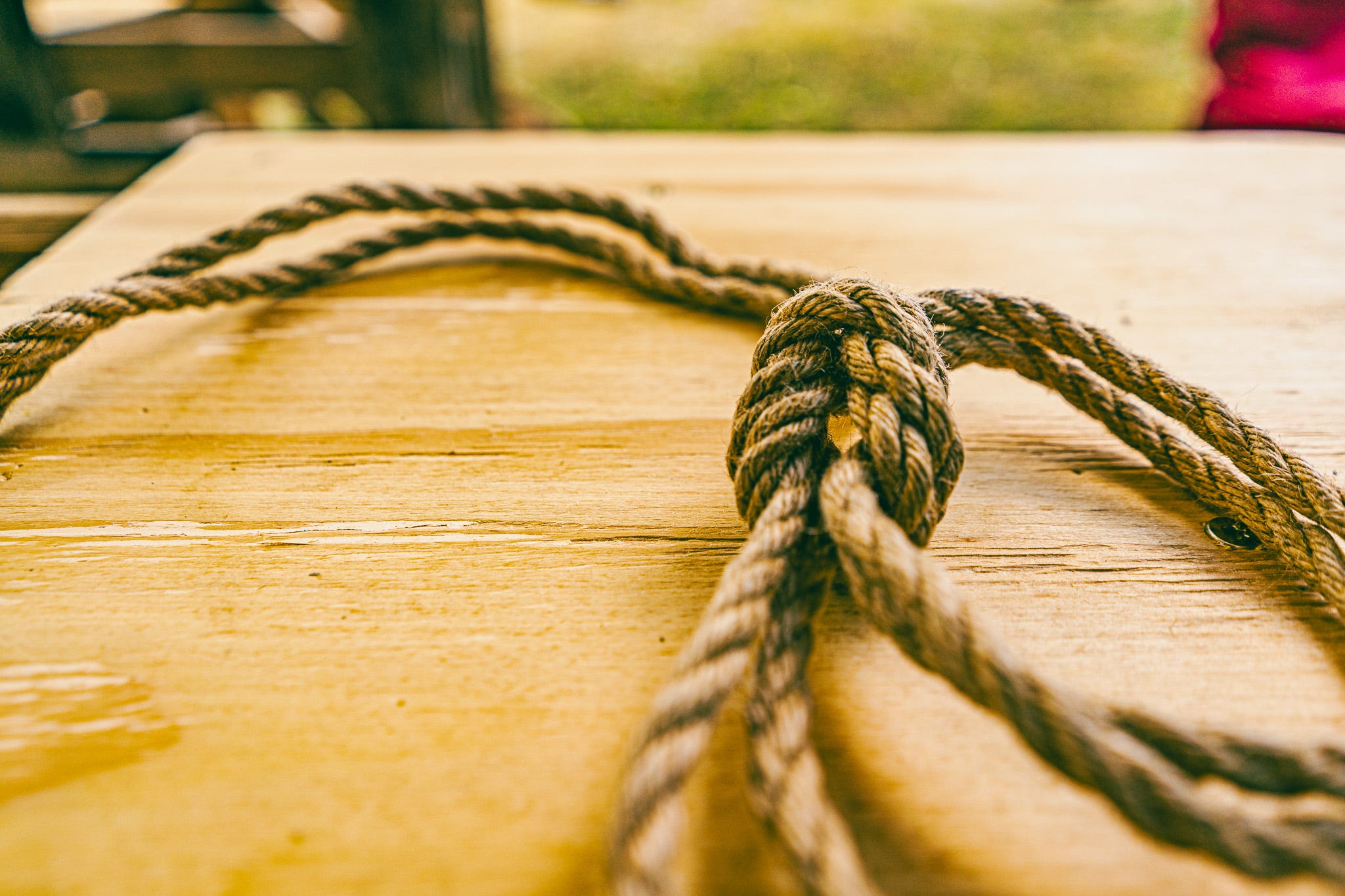
So what is a square knot? It is just two knots in opposite directions. You can do it over one wrap, two wraps, three wraps... Try tying one knot with the rope going above, then another witht the rope going below. This becomes tricky only because one side of the rope is very short and the other is very long. You'll want to perform the movements efficiently and, if possible, with only one hand so the other can hold the weight of your partner and they can relax. To achieve that, the second knot is done by creating a loop that closes over the small rope. Try that as well, a simple knot and a loop. The question, and the art, is how to get there efficiently, how to make sure the knot is closed properly and it doesn't move. How to do it effortlessly so the knot disappear.
So how can you do that? There are three points I like to say: that the rope has three dimensions and not one, that the strength of the knot comes from its friction, and that the pressure is the force divided by the area of contact, so make sure the tension of your ropes is even, and they don't cross each other!
About the dimensionality, think about the rope not as a thread, a one-dimension object, but as a volume. It has a surface and you can imagine it has four sides, the lower side, the upper side, and the lateral sides. Think about origami. Think about LEGO bricks. Now, the second point, remember that the strength of the knot comes mostly from friction. The rope wants to move but the ropes around it prevent it. The more surface the rope is touching, and the fact that the movements are opposing each other, is what increases the friction. A clean square knot has more points of contact and it is stronger. In a symmetric square knot, the ropes oppose each other more directly and the movement is more difficult. Look at the knot imagine each rope as a volume, and you will be able to see more details.
The last point is probably the most important one because it relates to safety. Think about this: why is it better to have four wraps than to have two? Intuitively we think it is safer and more comfortable. Think about a person being tied with a single very thin rope, you can almost feel the rope going inside the skin. The pressure in a surface depends on the area of the surface, the larger the surface the smaller becomes. This is the same principle that allows fakirs to step on a bed of nails, their body weight is distributed across all the nails. If they were to step on a single one it would pierce their skin. With rope is the same, if we have multiple wraps, the force of the ropes against the body distributes across all of them. But this only works if the tension in the ropes is equal and they don't cross each other. Try it yourself. In the place where the rope twist, only one rope is touching the surface, and therefore the pressure doubles. Similarly, if one rope out of the four is tighter, all the pressure is going to that rope while the other three are not contributing (the pressure multiplies by four!). This can damage the skin and pinch a nerve. If you are learning how to make a square knot, think about these two elements: are ropes twisting or crossing? Is the tension of all the ropes equal?
And remember, there is not a perfect knot, there is not a single knot, but all the knots are the same; all their elements are the same. Keep practicing and make yours better and better, by focusing on the details that matter.
Self-tying and improvisation
The last workshop didn't have many attendees, so we decided to do a self-tying practice. We started from the Futomomo, to continue with a few tricks to self-tie and improvise. In my practice, most elements are always the same: I start from a basic shape like a Gote, and then I continue following what the body is telling me, using friction and hitches along the way.
For the Futomomo part, we talked about how it matters tying from inside or outside the leg, depending on where we want to end. We talked about the best placement for the rope (close to the hip but not over it). We talked about where to apply pressure and where to be gentle (I like the rule of thumb: “don't be mean if there is no meat”). Then we talked about some execution details: how to bring one rope from below another one (pulling with your receiving finger rather than pushing with the one giving), how to hold the rope while tying to not lose the tension, or how to finish the rope in a way that allows us to continue tying afterward.
And then improvisation. Here the main aspect is how to use the two simple techniques of applying frictions and hitches, how to make sure that heavy parts of the body don't pull from smaller ones (for example, if you attach your torso to your toes), and how symmetry works both aesthetically and sensation wise. I must say I don't tie myself very often, but I found it fun and an alternative way to motivate myself to stretch. I should try more!
Now the camp has finished. I am writing this post sitting close to a DJ booth that is being disassembled. I feel very grateful for the experience and motivated to keep sharing my passion for the ropes. Here in Germany there are many knowledgeable practitioners, I am humbled and excited to know more about the community here.
I enjoy teaching workshops very much. I learned in Japan, where the teaching method is mostly about repeating without explanation. Whereas I think this is a powerful method that allows you to internalize the knowledge, I can see its limitations. It is slow and unattainable if you are not in Japan or don't have access to regular lessons. It is also not ideal to go beyond what is being taught. If you are like me, you need to understand why something is how it is.
Ropes are my passion, I think and learn about them every day. I hope this small text with some of my reflections can be useful in your practice. If you find this content valuable, please consider subscribing to my blog, so you can get notified when I publish new content.
Thank you very much for your attention,
Pablo Shibari
P.S.: Here is an image of the light installation made by my friend Reiterer: