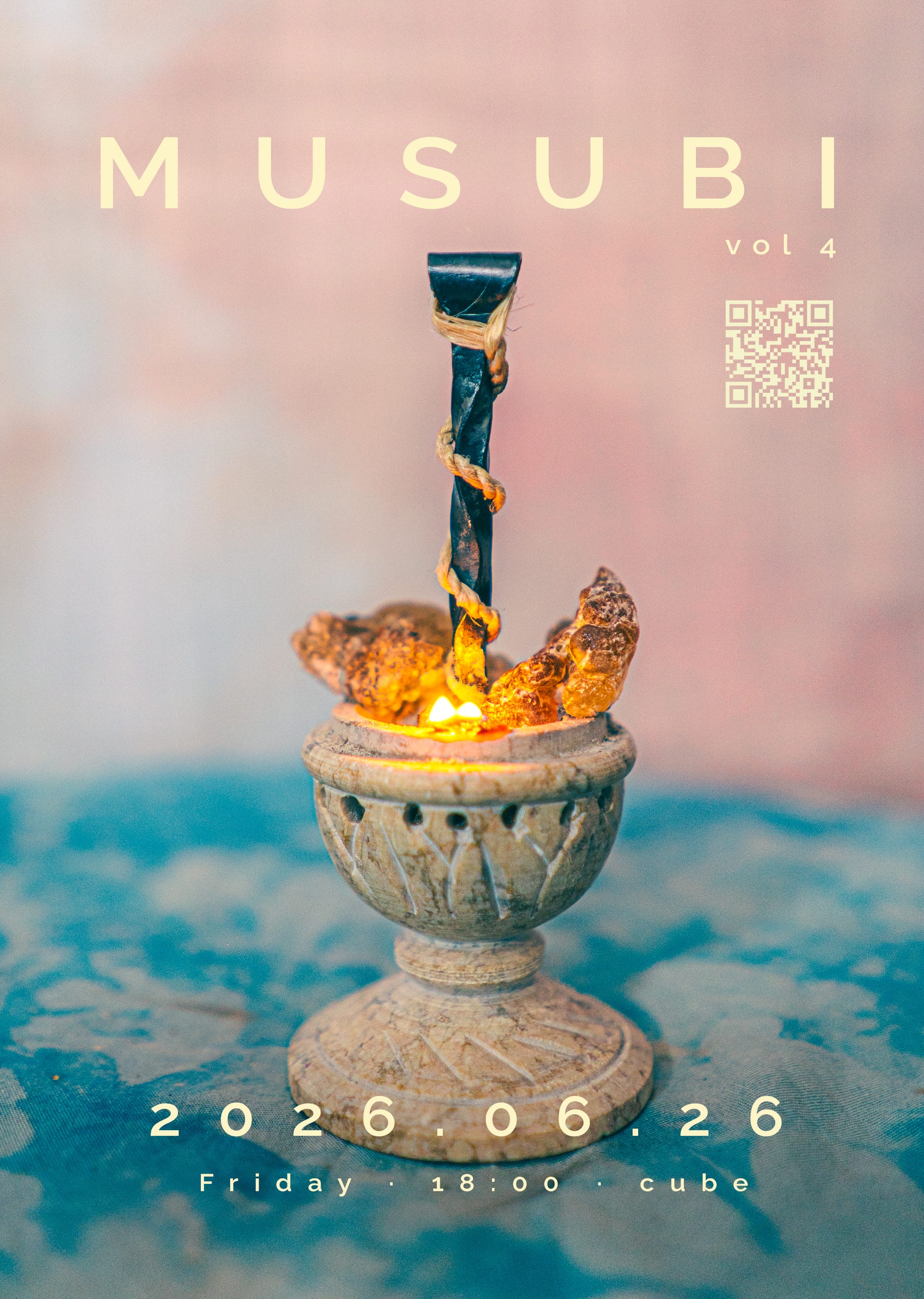
We are preparing the next Musubi for June 26th, and today I’ve been shooting the flyer. Before we post it I wanted to tell you the story behind the photography. I thought I was simply placing two objects together, but it turns out everything was already connected.
For every event I take a different picture that incorporates some of the elements we discovered in the previous month. Musubi is not a finished concept, but a living creature, a path we are walking. A path full of new adventures but also familiar faces.
Last month we went to Sanjo, a town in Niigata. Sanjo is the birthplace of my dear friend Mimi, who has collaborated with us many times in events, performances, and shootings. When we told Mimi that this year we were researching Yamabushi, she told us that actually her grandfather was a practitioner! A few weeks later we went to visit her town, where Mimi’s family runs a bath house.
In her house we could see a beautiful painting of Fudo Myo. She also showed us the back room of the facility, where the boiler heats the water for the baths. There was a small altar attached to the chimney. And the fire heater was gorgeous, a robust and proud machine.
It turns out that Sanjo is famous for iron works. We went to a nearby forge where we met a few locals who explained to us some of the ins and outs of working with iron. They showed us a ceramic grinder they use that costs more than 10M yen and needs to be changed every few months. They also said that only a few companies can manufacture them. It was interesting and put in perspective how knives and other metal items can be so expensive.
It was my birthday, and Mimi gave me a beautiful present. A nail.
There is a ceremony at the beginning of the year where they lit up the first fire. With this fire they create these nails, that later on are placed in the altars to express gratitude.
When I think about fire and iron, images of the industrial revolution come to mind. Charcoal, factories, workers in a production chain. These are not elements that I would associate with animism or even nature. I think about Saruman cutting trees, about Lady Eboshi killing wild boars. Iron and fire seem like a very human power, almost hostile. But humans are also part of nature. And so is what we call “artificial”. Even the infamous data centers.
Thinking about iron as part of a Shinto tradition was quite revealing, and it has changed the image I have of it. So I wanted to incorporate the nail into the picture. Also, in the next event Mimi will participate to talk with us about our trip together to Niigata.
The second element that I wanted to incorporate may be also misleading. It looks like rocks but actually it comes from a tree. Have you heard about Frankincense? Maybe you have seen it in aroma oils, or even in incense sticks, but have you seen it in its original form?
Two weeks ago I went to Miyashita Park, in Shibuya, to an event called City Green. Recently I am very interested in wellness, meditation, and so on, but I don’t go to these kinds of events that often. There was a shop that caught my attention.
Since a few years ago I have been trying to find someone who does Incense Ceremony. I’m sure you have heard about Ikebana, Calligraphy, or Tea Ceremony. Actually, in Japan there are several of these practices, all of them with a strong spiritual connotation, with the word “path” in their names. Ikebana, which is also called Kado, is the path of the flower, Calligraphy, which is called Shodo, is the path of writing, Tea Ceremony, or Sado, is the path of tea… and so on. There is one that is really not very popular, called the path of the aroma, or Kodo.
I have visited several incense shops and asked for any master or for places where I could practice, but I haven’t found any so far. When I saw this shop full of tiny instruments, smoke, ashes, and stone looking objects, I got very curious.
It turns out that they were a brand commercializing frankincense in Japan. I met the staff who explained to me about how it worked and also told me their story. They were super inspiring, and they talked about their work with much passion. They also asked me about myself. I was wearing a pendant made with hemp, and the story started from there. I told them about my practice, and how I wanted to incorporate something ceremonial regarding aroma. We talked about Musubi, and we even tied a piece of frankincense together. At the end they gave me two big pieces, one for me, and one for my daughter.
Two pieces that I added to the flyer.
Today after taking the picture I went to see them again. They are doing a pop-up in their shop as a collaboration with a ceramist. They invited me over and I was happy to get to know more about their work.
They have a beautiful and cozy shop in Asakusa, of course, full of frankincense, but also other objects to practice the ritual. Lighting up the frankincense is not that easy, which in my opinion is part of the charm. They showed me a good way to do it by burying the charcoal in the ashes to keep the burn slow.
They also invited me to ice cream. It seems you can also eat frankincense and even make honey out of it. The tree, called Sacra, blooms actually for quite a long time. Talking about flowers and peak experiences… Honey sounds like a good integration.
When I was leaving the shop something else caught my attention. There was a few vessels with dried flowers. I asked about it, and they said it is from an artist in Karuizawa.
“Actually”, they said “this is made with iron from Sanjo”.
There it was, the full circle. I thought I was putting two elements together to take a picture, but actually everything was already connected. We just need to find the path. A path that sometimes you follow with your nose.
Thank you for reading Rope Meditations,
Pablo Aida